

Start here
Reading your tasks, meetings and pipeline…
Today
Open calendar →
Today's agenda
Reading today's diary…
Tools
Rapid execution
Leads for Ambrus
Next best openers for the tail hedge
Three highest-probability firms to research now — and what's outstanding on our side before the IC.
Ranking your contacts for this mandate…
Blockers — our side
Checking tasks and deal actions…
Owed by us
Task tracker →
Your tasks
Reading the task tracker…
Owed to us
Comms Hub →
Awaiting from counterparties
Reading the minutes…
Gone quiet
Queue all →
Re-engagement
High-value contacts with no contact logged for 90 days or more.
Reading the record…
Warm · unapproached
Looking for warm contacts left cold…
Signals desk
Market intel →
Market wire
Live macro and headlines matched to our managers' strategies.
Checking what moved
Reading the wire…
Pipeline momentum
Deal pipeline →
Deal volume
Open deal value by manager, from the live pipeline.
Loading pipeline…
By project
Reading the task tracker…
Outreach pacing
—
Counting logged activity…
Pipeline value
—
Reading open deals…
Meetings & calls
—
Reading the diary…
This week
Mon 20 — Sun 26 July
Everything due, then today in detail. Each item links to the tool it belongs to.
Today
Loading today…
Weekly meeting
Weekly meeting
Loading…
People
Annual leave
Loading…
Firm dossier
Our relationship
Recent activity
What they buy
Documents on file
Next
Mandate fit
In the news
Change history
Contact dossier
Our relationship
Previous communications
About their firm
Portfolio makeup
How they decide
At this firm
Everything else on file
Mandate fit
Execution
Task Tracker
Every live task — grouped by project or by person. Tick it off when it's done; open a card to edit.
Tool
Cap Raise
Seeker's own raise. Shared documents anyone here can add to, and a target-investor list linked to your contacts — click any investor to open their record.
Cap raise
Documents
Intelligence
Market Intelligence
The embedded competitor + data engines. Honest by design — never a synthesised NAV, and the signals engine never asserts a market condition. The AI market reads are Claude’s reading of the wire, labelled as such, not fact. Kept what earns its place; dropped the rest.
loading…
Insight · management
Progress Reports
Is the raise working. The money, the meetings, the replies and the outreach — then the funnel that produces them and the people doing the work.
Deal pipeline & forecast
Subpage · weighted value and win rate, from the deals boardTeam effectiveness
Every project with tasks, ordered by what is overdueCoverage by segment
Answer
—
Ask a question to see an answer here.
Saved answers
Loading…
Getting started
How to use the Platform
Everything you need for your first week, in the order you will actually need it. Fifteen minutes to read; keep it open beside you the first few times.
Watch first — short videos
Ten minutes, and you'll know your way around. Everything below is here as reference for afterwards — you don't need to read it before you start. Click a video to play it larger.

1. Welcome to the Platform
The big picture — why it exists, and how the four areas fit together. 3 min.
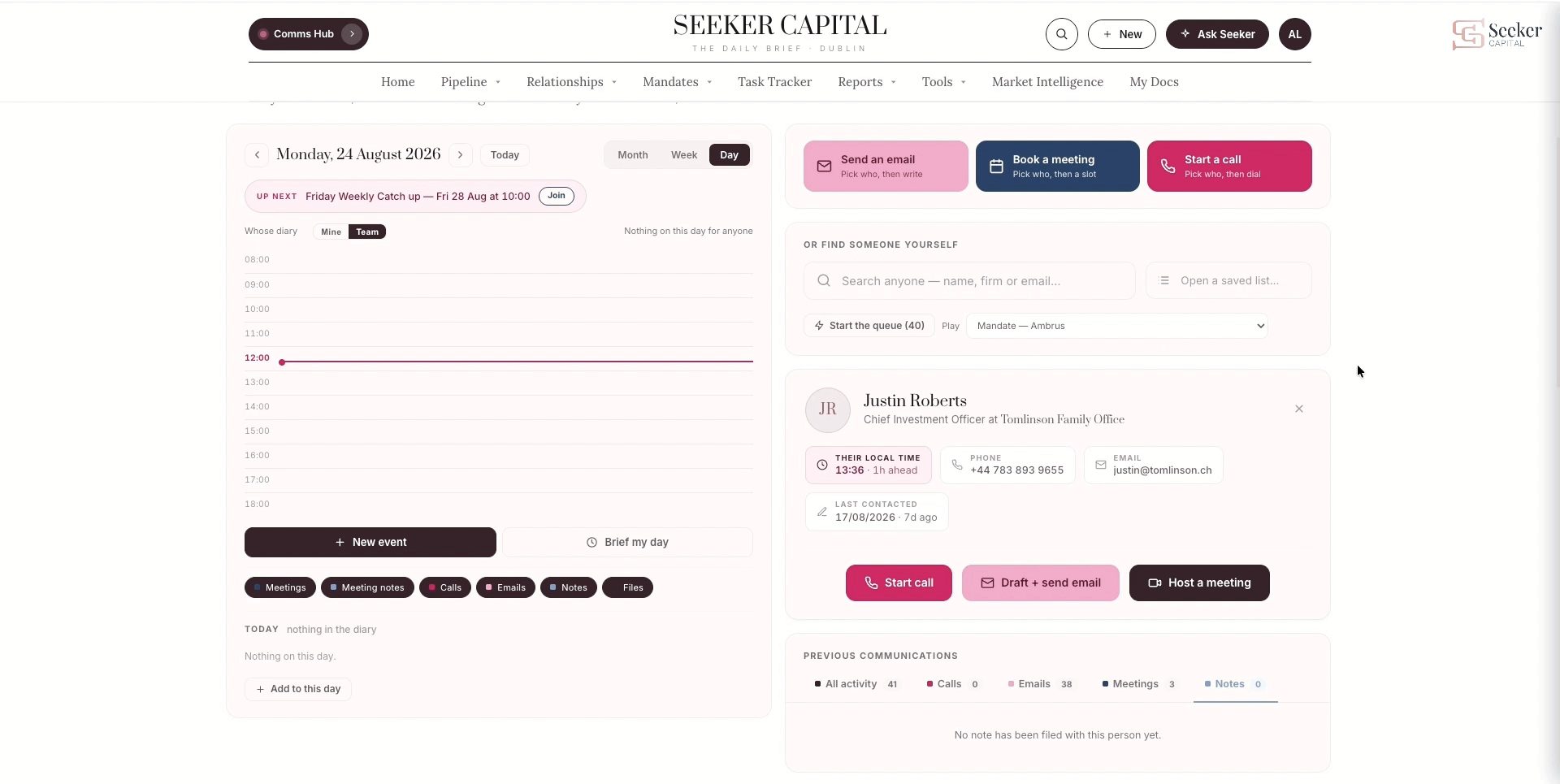
2. Your daily workflow: the Comms Hub
Search a contact, write an email, log a call, and where the notepad and Playbook sit. 3 min.
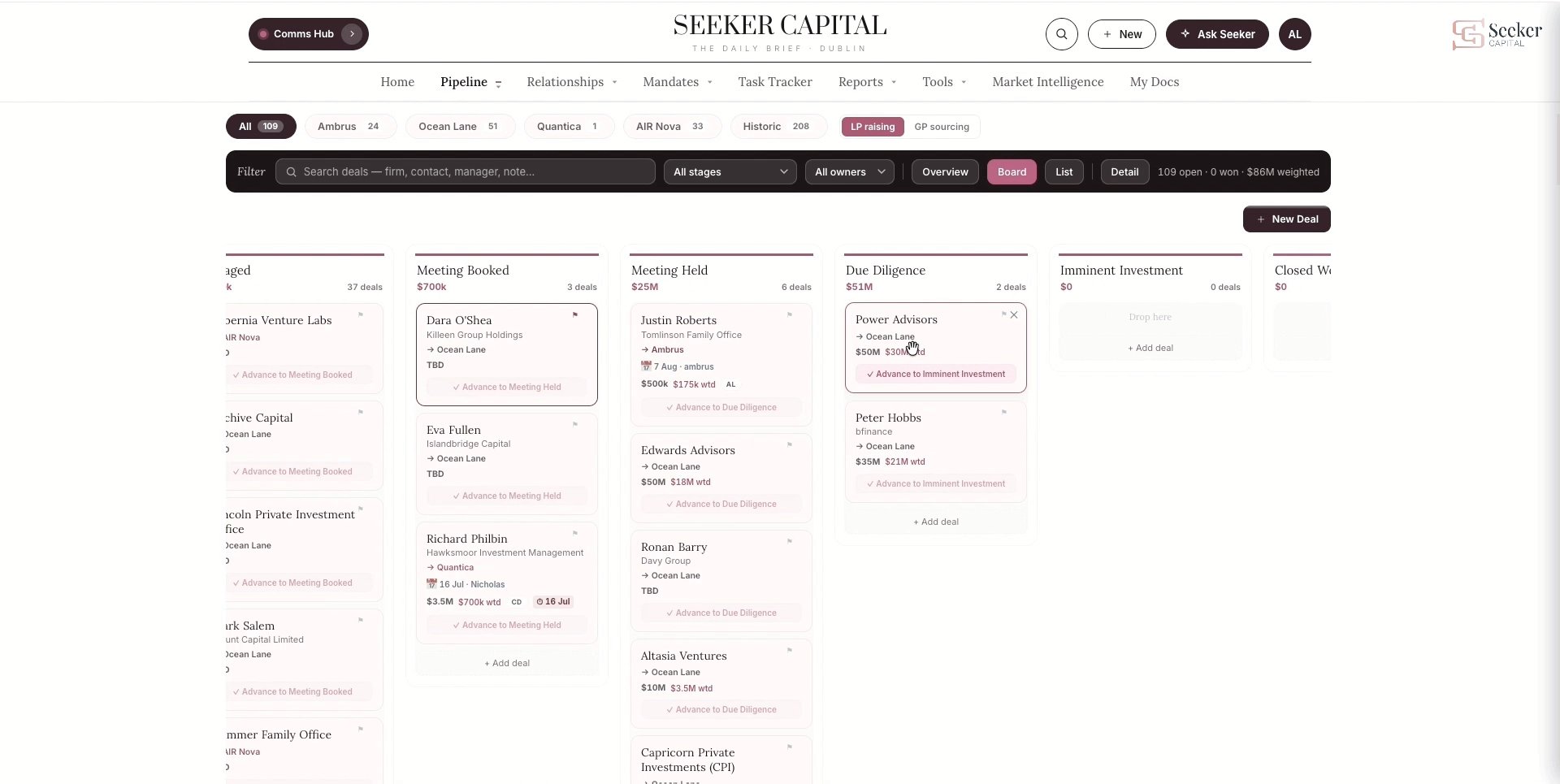
3. Working a mandate: the Pipeline
Move a deal through its stages, and how the Approved Target List's ticks sync with it. 3 min.
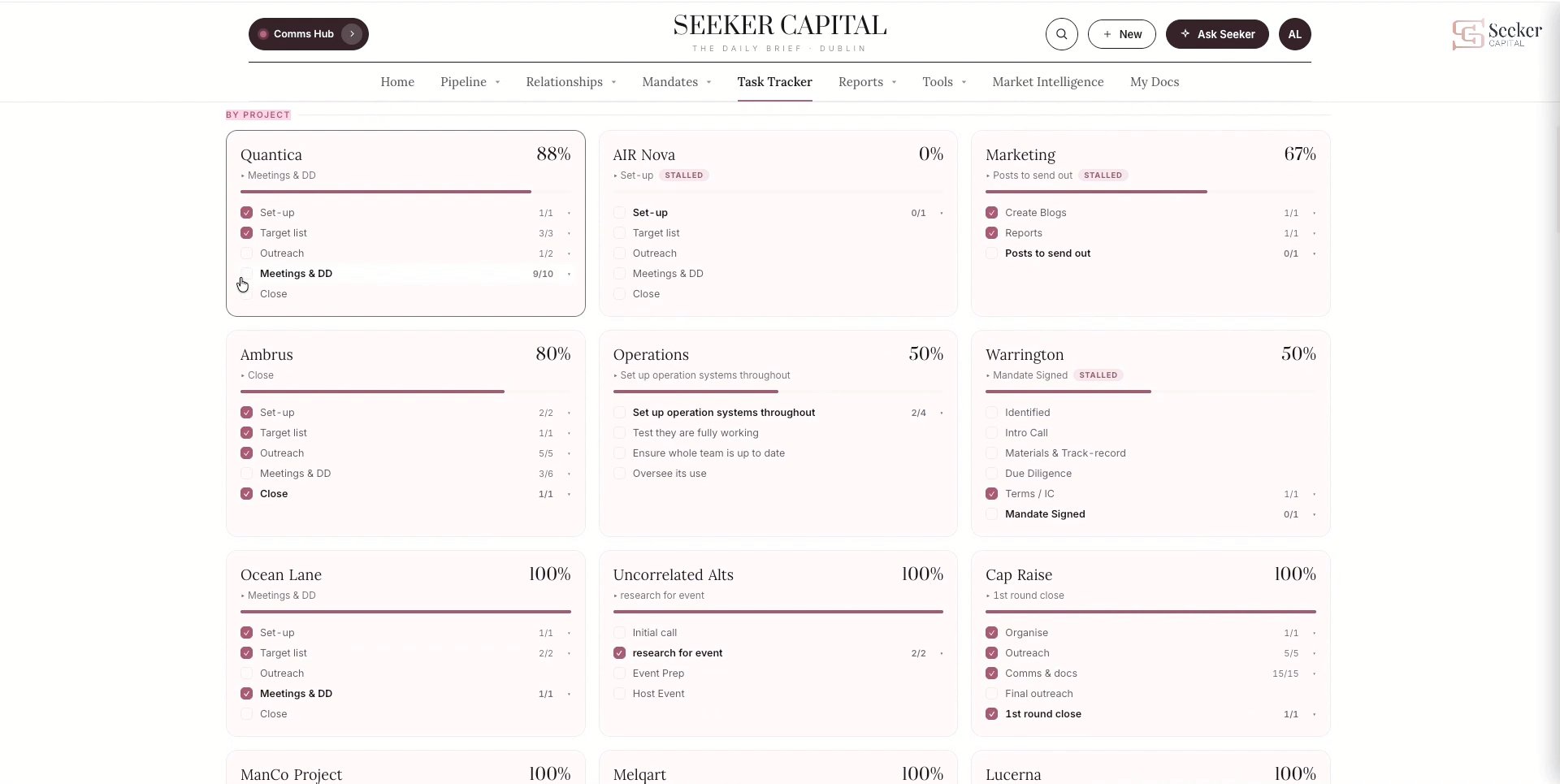
4. Task Tracker
What's due, marking it done, and why it's the same list as seeker-tracker.com. 1.5 min.
The one number that matters
Meetings booked, per mandate, per week. Everything in here exists to move that number. Calls and emails are how you get there, not the point — the CRM counts them so you can see whether the week is on track, and the weekly shape we work to is 30 calls · 100 emails · 50 LinkedIn · 5 meetings each.
Before anything else — five minutes
- Sign in with your Seeker email. One login; the Task Tracker no longer asks for a second.
- Open your Profile (your initials, top right → Profile) and fill in your job title and phone. These two are the only things the email signature can't work out for itself. Your signature appears underneath as you type — it is added to every email you send, so you never paste one again.
- Check your name reads properly. Emails now go out showing your full name, not a mailbox stub. If the preview looks wrong, tell Ava before you send anything.
The daily loop
This is the whole job, four steps. Everything else in the menu supports it.
- Find who to talk to. Relationships → Contacts or Firms Narrow with the filters until you have a group worth a morning — country, allocator type, mandate fit, when they were last contacted. If you don't know where to start, use Tools → Find Allocators, which ranks the book against a chosen mandate.
- Save that group as a list. "Save as list", top of the table Name it for what it is ("Swiss multi-FOs, not contacted in 90 days"). A list is a working queue, not a report — it is there to be worked through and finished.
- Work it in the Comms Hub. The "Comms Hub" button, top left of every page Find your list, and it steps you through it one person at a time — Person 3 of 41, Previous and Next. Each person arrives with everything on one screen: their history, the call button, the email box, the Playbook, their local time and your notepad. You do not go looking for anything.
- Log what happened, while it is in your head. Calls and emails sent from the CRM log themselves. A conversation that happened anywhere else — a call on your mobile, a chat at a conference — only exists if you write it down. An unlogged meeting is one nobody else can build on.
Writing the email
This is the part people get wrong, and we have the evidence for it. Across 1,826 sent emails: an email written once for one person got a 14.2% reply rate. A reused template got 2.8%. Five times the reply rate for a few minutes' work, and the difference is not close enough to be luck.
- Use the Playbook as a scaffold, never as copy. It gives you the shape of a good approach. The words have to be yours and about them.
- "Draft with Claude" is a first draft, not a send. Read every line. It knows the mandate; it does not know what you talked about in June.
- Never write "quick 15 min?" — it is the worst-performing opener we have.
- Half of all replies come within 0.7 days. If you are going to follow up, follow up.
Where everything lives
MandatesA dashboard per fund — the terms, the target list, who has been
approached and what came back. Start here when you are asking "who should I call about Ambrus?"
PipelineEvery live opportunity by stage. Move a deal on when something real
happens, not to tidy the board.
Task TrackerYour actions and everyone else's, by project or by person.
Weekly MeetingMonday's team call, and the Friday session that shapes it.
The pipeline dates are read from the CRM rather than typed, anything that was on last
Monday and is not on this draft is listed so dropping it is a decision, and an action
agreed on the call becomes a real task.
Annual LeaveWho is off, and what everyone has left. Booking a range skips
weekends and bank holidays for you. It also fills the "Annual leave" heading on Monday's
agenda, so nobody has to remember who is away.
Outreach ScorecardYour week against the weekly shape. It is a mirror, not a stick.
Market IntelligenceWhat is moving in the market, and what competitors are doing.
Cap RaiseThe raise itself — deck, target list, progress.
Marketing ContentEverything we publish. The Blog Formatter lives here too.
My DocsYour own documents, written and stored in the Platform.
Four things that will save you
- Search from anywhere with Ctrl K (⌘K on a Mac). People, firms, pages. It is faster than the menu every single time.
- The arrows beside the search box are Back and Forward through the Platform itself — not the browser. Use them to bounce between a firm and the people at it.
- A filter that returns nothing usually means the wrong filter, not an empty world. If a search of 14,000 people returns zero, loosen it before you believe it.
- Never bulk-archive anything. Being able to see a record matters more than a tidy screen, and archiving hides people from everyone, not just you.
When something looks wrong
Say so, with the detail. "The Firms filter is broken" cannot be chased; "filtering Firms by Switzerland + Multi-FO gave me 0, and I know there are Swiss multi-FOs" gets fixed the same day — that exact report is how a real bug was found in August. A number that looks wrong usually is wrong, and it is worth thirty seconds of your time to report it.
Marketing
Blog Formatter
Paste a finished article straight out of Word. It comes back laid out in Seeker’s house style, ready either to go on the website or to hand to somebody as a document.
1 · Paste the article
Select all in Word (⌘A), copy, and paste in here. Keep the headings and bullets as they are —
that is what tells the formatter what each line is.
Document / PDF is the one to hand somebody — charts included, nothing else needed.
Download page + Download images gives you the finished
🔴 Insights articles need Thornbridge sign-off before they go public.
Download page + Download images gives you the finished
insights-<name>.html and the charts already named to match it; drop the images
into assets/img/insights/ and the page finds them, nothing to rename.🔴 Insights articles need Thornbridge sign-off before they go public.
Account
Profile
Your details, signature and defaults — off the content nav, under the avatar.
Name—
Email—
Role—
Personalised brief● On — Home is yours; common pages standardised
Job title
Phone
LinkedIn
Your email signature
Added automatically to every email you send from the CRM — you don't paste it, and you can't
delete half of it by accident. Fill in your title and phone above and it updates here.
Use the same signature in Gmail
The CRM signs emails you send from here. For the ones you write in Gmail, copy it across
once — then every email matches, wherever you wrote it.
- Press Copy my signature above.
- In Gmail: Settings ⚙ → See all settings → General → Signature.
- Create new if you have none, then click into the big box and paste (⌘V).
- Underneath, set signature defaults to it for new emails and replies.
- Scroll to the bottom and press Save Changes — Gmail discards it otherwise.
Paste it plain, don't retype it. If the logo doesn't appear, Gmail is blocking images —
press Display images below on any email and paste again.
Account
Team & Admin
Roster and per-person auth. Deactivated members are preserved (owner links intact), never deleted.
Loading the roster…
Account
Access log
Who accessed what, when and from where — with the route each person took and the exact before → after of every change. Restricted to Ava; Workers are auth-gated and origin-scoped.
Loading the access log…
Account
Data & imports
Occasional bulk clean-up — imports, dedupe, enrichment and the verification workflow. Kept out of the daily path.
Import
Excel or CSV → Contacts and Firms. You map the columns, see what will happen, then apply. Every import is undoable.
Open importer
Dedupe
FK-safe merge proposals for review — never merges without approval.
Find duplicates
Enrich & verify
Web + LinkedIn verification, cursor by verified_at. Lusha at contact level.
Resume verify
Account
Settings
Workspace, integrations and display.
Twilio dialer● Connected · US1 edge · Ireland enabled
Call recording● On · settled (Thornbridge signed off)
Email + calendar● Google Workspace · migrating mailboxes
Region & formatDublin · DD/MM · metric · USD fund sizes
DisplayLight · Prata / Lora / Inter · mono-rose
Retire the old type column
The Platform still keeps a legacy
category column alongside the real type. This writes the type each contact already shows as onto the record, so the old column stops being load-bearing and can be deleted. Nothing on screen changes — that is the point.
Saved views
Simplified mode
Hides the scores, the gates, the counts and the filters nobody needs mid-meeting — everything except search, owner and type. Forms drop to one page. Nothing is removed from the record and nothing is rounded off: a record filled in simplified mode is the same record. Saved for you, in this browser.
Layout & look
Point at anything on the page and change its spacing, type, colour or layout yourself. Saved in this browser only — the team sees the CRM unchanged. Alt+Shift+N from anywhere.
Progress Reports
Outreach Scorecard
The same people and channels as the team table on Progress Reports, plus the three things that only live here: manual top-ups for LinkedIn, the per-mandate filter and the twelve-week roll.
Comms Hub
Call history
Every call auto-logged from the in-Platform dialer, with disposition and duration. Feeds the scorecard and each contact's timeline.
🔴 Recording stays off until the Thornbridge sign-off. Dispositions and duration log regardless.
Time · Calendar
Meetings
Meetings link back to the firm dossier; branded minutes auto-attach, and party-lane tasks split our actions from their commitments.
Tool
Marketing Content
Everything Seeker publishes, in the order you need it: what's dated, what needs you, what's in production, and the Barometer.
The month ahead
Loading the calendar…
Needs you
On the wire · our feeds
In production
Marketing we don't run yet
Workspace
My Docs
Write and keep documents inside the Platform. Mine is yours alone; Team is shared with everyone at Seeker — the curated Lists live there too.
Documents
No document open
Pick one from the index on the leftabove, or start a new one.
Outreach
Communications Hub
The day on the left, the work on the right. Pick what you want to do, then who with.
The day
Who do you want to email?
Or find someone yourself
Pick what you want to do, or search a name
Their whole record opens here — the dossier, everything ever said to
them, and the notepad and the playbook underneath.
People
Contacts
Role-aware profiles across the register — allocators, managers, service providers and introducers. Click a name for the dossier.
Tool
What's Working
The feedback loop. Everything on this page is computed from the email actually on file — it moves as the book does. The July 2026 study that set our writing rules is kept at the bottom, as the benchmark to beat.
The July 2026 study — the benchmark, not a live counter
A one-off analysis of 1,826 emails on 17 July 2026. These four numbers are frozen at that date and are what the writing rules below were derived from. Compare them only with the first approach figure at the top of the page — the study measured cold approaches, so putting it beside a rate that includes replies inside live conversations would show an improvement nobody made.
Written-once reply rate
14.2%
vs 2.8% any-reuse · z=3.20
"Quick 15 min?" close
7.9%
worst · vs 22.7% best
Open rate
~78%
either way · body is the lever
Median time to reply
0.7d
when it lands
Rules this evidence writes
Write every body once — no reused paragraphs
5× the reply rate
Never close with "worth a quick 15 minutes?"
Removed from every scaffold
Log the outcome after every send
Adoption is the gap — only a handful logged so far
What the logged outcomes say
The live counterpart to the study above — read from the outcomes actually logged, so it grows as the team logs them.
Tool
Import a spreadsheet
Drop in an Excel file or a CSV — a list of contacts, a conference delegate list, a data provider's export. You say which column is what, see exactly what will happen, and only then does anything get written. People go to Contacts, their firms go to Firms, and the two are linked. Every import can be undone.
1 The file
2 The columns
3 What will happen
4 Done
↑
Drop a file here, or click to choose one
Exported a mailbox instead?
An Outlook .olm is a whole mailbox, not a spreadsheet — it belongs in Import Outlook mail, which logs the email in it as activity against the people it was with. Drop one here anyway and you will be taken there.
What it does with a row
One row usually describes a person and the firm they work at, so it becomes two records: the person under Contacts, the firm under Firms, linked together. A firm we already hold is linked rather than duplicated. Anything the sheet does not say is left blank — nothing is filled in with a guess.
Past imports
Mandates the old importer may have written
Until today the importer stamped mandate: Multiple on every contact it created, alongside three other invented values. contacts.mandate is the field the Approved Target List reads, which is why it has been marked unusable. This counts how much of it carries that fingerprint.
Tool
Import Outlook mail
Drop in an Outlook archive (.olm) and the email in it becomes logged activity — on each person's record, on their firm, and on your Outreach Scorecard. The file is read on this Mac and never uploaded. Only mail to or from someone already in the book is imported, so personal mail stays out. Nothing is written until you have seen the list.
1 The file
2 Reading it
3 What will happen
4 Done
↑
Drop your .olm here, or click to choose one
How to get the file out of Outlook
In Outlook for Mac: Tools → Export, tick Mail, and save the .olm somewhere you can find it. On Windows Outlook the equivalent export is a .pst, which this cannot read yet — say the word and it can be added.
What gets imported, and what does not
Imported: each business email, as a logged activity with its real date,
direction, subject and opening lines, attached to the person it was with and to their firm,
credited to the mailbox's owner so it counts on the scorecard.
Not imported: mail with someone who is not in the book yet (they are listed for you
to add), internal mail between the team, newsletters and system mail, Junk, Deleted and
Drafts, and anything already logged. Attachments and calendar entries are not imported —
this pass is email only.
Tool
Verify contacts
Check one person against Lusha and a sourced web search, then decide field by field what goes into the record. Nothing is ever written until you tick it and press apply.
Pick somebody to check
Three ways in: search for one person, pick a saved list to work through it in order, or press Next unchecked to sweep the whole book oldest-first. Verifying needs a name and a firm — the question being asked is “does this person still work there”.
Each check asks three sources — our own record, Lusha, and a web search that must cite the pages it found — across six fields: firm, title, work email, phone, LinkedIn and location. It also asks the question that matters most: is this the same individual, or someone who shares the name.
Tool
Classify contacts
Everyone with no contact type, grouped by firm. Set a firm’s type once and it answers for everyone there. Nothing is written until you press apply.
Reading the book…
Tool
Find Allocators
Describe the allocator you want and Claude goes and finds them — web-verifying each candidate is still operating, pulling current contacts, and flagging compliance risks before anything reaches the register.
Try: “Pension funds in the Nordics over £1bn with alternative-credit allocations” · “UK EAMs serving HNW clients with appetite for systematic CTAs”. Results are candidates, not records — nothing is written to the CRM until you add it. The eligibility gate (aligned-LPs-only for Ambrus) applies before fit is shown.
The register
Firms
Every firm as a dossier — click a row for the working record, or open its command centre.
Sales
LP Pipeline
Probability-weighted, across every live mandate.
Weighted forecast · this quarter
—
Gross—
Open deals—
Data
Verify firms
Check one firm against Lusha and a web search that has to cite its pages, sort out which records are branches of one group, or run a bulk pass. Nothing is written without you.
Product
Mandates
Every live mandate — the fact sheet we hold, its approved target list, and where it stands in the pipeline. The future ManCo "fund master" would extend from here.
Product · pipeline
Prospect Mandates
Every manager we might sign, closest to signing first, with what is in the way and the work behind each one. This is the GP pipeline.
Diligence
Manager DD
Due-diligence scorecards behind each manager — track record, drawdown against volatility, correlation, return and AUM, against the five guardrails. Track record is reported honestly, never a synthesised NAV.
New-manager guardrails
Tool
Matchmaker
Ranked allocator × mandate pairings across the whole book, with the reasoning behind each score — so time goes to the highest-probability pairings.
Score is mandate FIT behind the eligibility gate — relationship warmth is a separate axis and deliberately not in it. Open a row for the full signal-by-signal breakdown.
Relationships
Lists
Working sets — a trip, a mandate push, a close priority. Open one to filter the register down to it.
Record
Activities
Every logged communication across the book — calls, emails, meetings, notes and tasks. This is the source the scorecard counts from.
Insight
Weekly Digest
What actually happened this week, by mandate — written to be read in two minutes and sent to the team.
Record
Notes
Every note written against a contact or mandate, newest first, beside the live activity feed.
All notes
Activity feed